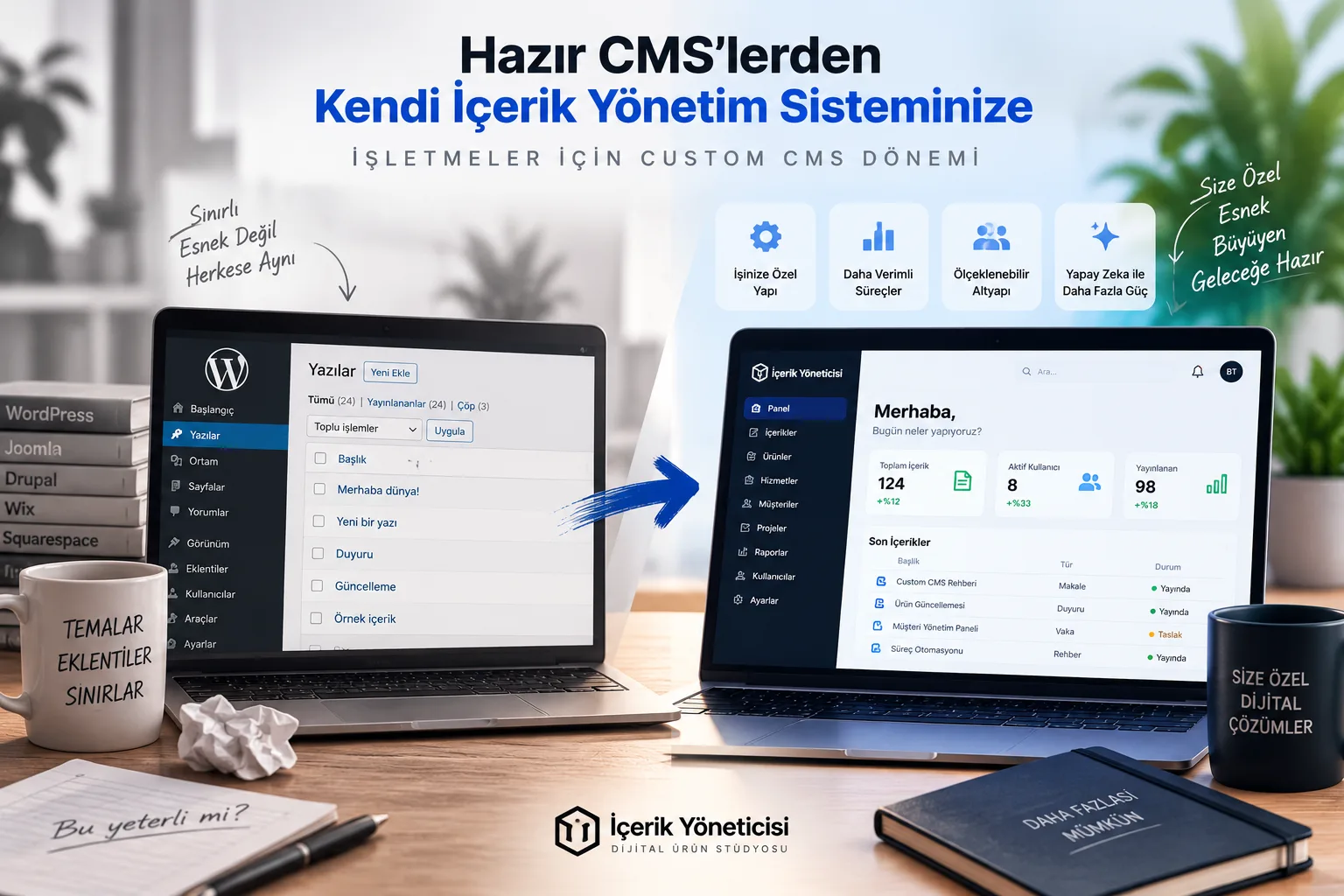
When you want to set up a website, one of the first solutions that comes to mind is using an off-the-shelf CMS.
That approach has made a lot of sense for many years. WordPress and similar ready-made content management systems make it possible to publish quickly without building the technical foundations from scratch. Themes, plugins, user management, content editing and many other basics come ready-made.
But as businesses grow, another question appears:
Should the company fit the way it works to the CMS it uses, or should the CMS be designed around the way the company works?
In my view, one of the important digital product debates of the coming period starts exactly here.
## Why have off-the-shelf CMS platforms been so successful?
The main reason they are strong is simple: they standardize problems that come up again and again.
If a company needs to;
- create pages,
- publish content,
- upload images,
- create users,
- manage menus,
- write a blog
then using a ready-made CMS is often faster and more economical than building all of that from scratch.
So it isn't right to see off-the-shelf CMS platforms as unnecessary or poor solutions.
For a business with standard needs in particular, a ready-made CMS can still make perfect sense.
The problem isn't that the CMS is off the shelf.
The problem appears when the business's needs start to exceed the limits of that ready-made structure.
## Not every company works the same way
Content management in a company may be about far more than "add a post, upload an image, publish".
A business may have its own;
- product structure,
- services,
- customer processes,
- user roles,
- approval mechanisms,
- content types,
- reporting needs,
- workflows,
- ways of presenting things,
- data relationships.
And all of these can differ from company to company.
The content management needs of an e-commerce company are not the same as those of a software company, an education platform, a healthcare provider or a company managing many different services.
Even so, many businesses gradually start bending the way they work to the model their current CMS offers.
Past a certain point, instead of the system supporting the company, the company starts supporting the system.
## When does an off-the-shelf CMS start falling short?
There's no hard rule saying "once you reach this size, use a Custom CMS".
The real measure isn't company size but the complexity of its digital needs.
For example, if these needs have started to appear in a business, a bespoke content management system may be worth considering:
- If data models beyond standard content types are needed
- If custom user and permission roles are needed
- If more than one workflow has to be managed
- If content has to be linked with other systems
- If the admin panel needs to be designed around how the company actually works
- If solving things with ready-made plugins is getting more and more complicated
- If the same operations are done manually over and over
- If custom relationships are needed between content, product, customer or operational data
then it may be more sensible to think about a digital platform built for the business, not just a CMS.
## What exactly is a Custom CMS?
A Custom CMS is more than adding a few custom fields to an existing CMS.
The basic idea is this:
> The data model, admin panel and workflows of the content management system are designed around the business's real needs.
In this approach, instead of asking "which CMS should we use?" first, another question comes first:
"How does the business actually work?"
Then that way of working is turned into a digital system.
For one company, content may not just mean articles.
Relationships may need to be built between articles, services, products, authors, categories, customers, projects, documents or other bespoke content types.
In that case the admin panel can be designed to understand that structure too.
## The difference between a Custom CMS and a website
Building a bespoke CMS doesn't just mean changing how the website looks.
The real difference is at the back.
On a classic website, a simple structure like:
Content → Page → Publish
is often enough.
On a bespoke web platform, a far broader structure can be built:
Content → data model → relationships → user roles → workflows → publishing → other systems
That's why a Custom CMS shouldn't be thought of as just "a prettier admin panel".
What is really being built here is the company's digital operating infrastructure.
## So why shouldn't everyone write their own CMS?
Because custom software isn't the right answer in every case.
Building a CMS from scratch for a standard website can create unnecessary cost and maintenance load.
If a ready-made system meets the need completely, using it is usually the better decision.
A Custom CMS becomes meaningful at the point where the ready-made system falls short.
In other words:
Building custom software isn't a goal; it's an answer to a need.
That distinction matters.
Because building a bespoke system just to "use our own technology" isn't a sound strategy.
## AI is changing this equation
One of the most important shifts of recent years here is AI-assisted software development.
In the past, a small business building its own CMS or admin panel could require a serious amount of time and development resources.
Today, AI-assisted development tools can help developers with processes such as;
- code generation,
- prototyping,
- documentation,
- testing,
- debugging,
- repetitive development work.
This doesn't remove all the costs of building custom software.
A good product still needs the right architecture, security, tests, maintenance and human oversight.
But speeding up parts of the development process makes it possible to revisit bespoke solutions that previously looked hard to justify economically.
In my view, that's where the real change is.
AI doesn't mean "every company should write its own software".
It lowers the development barrier to solving a company's distinctive digital needs in a bespoke way.
## From CMS to web platform
Past a certain point, a company may need more than content management.
The admin panel may need to manage different structures together, such as;
- content,
- products,
- services,
- users,
- reports,
- documents,
- workflows.
At that point, rather than "which CMS should we use?", it makes more sense to ask:
"What kind of web platform do we need?"
A Custom CMS may be only one part of such a platform.
In a larger structure, the CMS, admin panel, user system, APIs, integrations and different operational modules can all work together.
## Off-the-shelf CMS or Custom CMS?
These two approaches don't have to be seen as technologies at war with each other.
The better approach is to decide based on the need.
| Need | Better fit |
|---|---|
| Standard corporate website | Off-the-shelf CMS |
| Simple blog / content site | Off-the-shelf CMS |
| Fast, low-cost start | Off-the-shelf CMS |
| Bespoke content types | Consider a Custom CMS |
| Custom user roles | Consider a Custom CMS |
| Complex workflows | Consider a bespoke web platform |
| Custom integrations with several systems | Consider a bespoke platform |
| An admin panel built for the business | Custom CMS / custom software |
| Managing content and operational processes together | Bespoke web platform |
So the question is broader than "WordPress or Custom CMS?".
The real question is:
Is the business's need standard, or does it call for a digital product of its own?
## A new era: software shaped around the business
Given where web technology now stands, we're moving towards a period in which businesses don't have to squeeze their digital needs into ready-made moulds.
That doesn't mean off-the-shelf CMS platforms will disappear.
On the contrary, ready-made solutions will keep being used for standard needs.
But if a business's competitive advantage comes from its own processes, data, customer experience or operations, it becomes more important for its digital infrastructure to reflect that difference too.
At that point a Custom CMS stops being merely a content management system.
It becomes a digital product that understands how the business works.
## Conclusion
You don't really have to say "goodbye" to off-the-shelf CMS platforms.
That isn't the right question.
The right question is:
Does a ready-made system really meet our need?
If the answer is yes, using an off-the-shelf CMS is the right choice.
If the answer is no, then instead of constantly adding plugins, straining the system and bending the way the business works to the technology, designing a Custom CMS or web platform that fits the business may be the better move.
AI-assisted development also makes that option more accessible than it used to be.
What matters in the period ahead isn't that everyone writes their own CMS.
It's that every business can choose the right technology for its own distinctive digital needs.
Sometimes that will be an off-the-shelf CMS.
Sometimes a Custom CMS.
And sometimes a fully bespoke web platform or SaaS product.
The point isn't to fit the technology to the business, but to put in place technology that serves the business's needs in the right situation.

 MakaleFeatured
 MakaleFeatured