In a meeting last week I heard this: "We use ChatGPT too, everyone on the team uses it."
Then I asked: "So what happens when your customer comes to your site and asks whether their package includes something?"
Silence.
Because nothing happens there. The team uses AI at their own desks, but the company itself still runs without it.
The AI tools we use today know the world's knowledge. They've read millions of books, articles and forum threads. But they don't know your price list. They don't know which services you offer, what you do in which situation, or the new package you launched last month.
They can't know. Because that knowledge is with you.
Where general AI gets stuck in your business
Let me make it concrete.
Say a customer comes to your site at eleven at night and asks: "Can I upgrade my package a month from now, and how is the price difference calculated?"
A general AI can answer that in three ways. It says "I don't have information about that". It explains how the industry generally does it — which may have nothing to do with how you do it. Or, worst of all, it gives a plausible-looking but completely made-up answer.
All three are bad for you. The first sends the customer away empty-handed, the second creates the wrong expectation, the third does direct damage.
And yet the answer exists on your side. It's written in your help documentation, your support team says it five times a day, maybe it sits in a spreadsheet. There simply is no link between that knowledge and the AI.
That link is exactly what we build.
What we mean by "your own AI"
I want to be clear here, because there's a lot of overblown talk in this space.
We're not building you an AI model from scratch. Nobody is — that takes billion-dollar infrastructure and is unnecessary anyway. We're not training a model either.
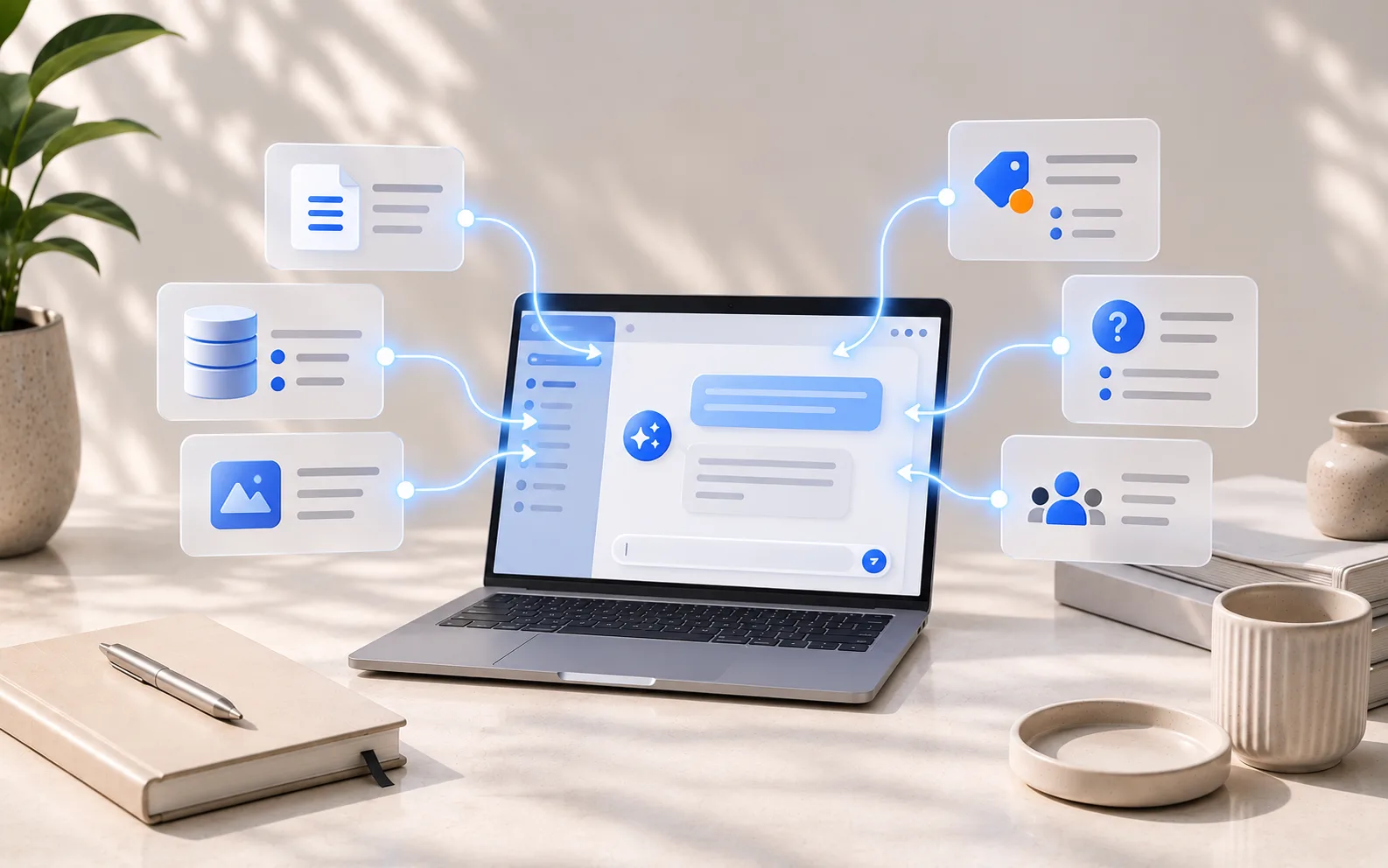
Here's what we do: we take a powerful language model and give it your knowledge. Your services, product details, pricing structure, frequently asked questions, documents, company policies — whatever information is yours.
The result is an assistant that knows the world but talks about your business.
The difference is this: ask a general AI "what's your returns policy" and it tells you the general things it learned online. Ask your assistant and it tells you your returns policy. Because it isn't reading from somewhere else; it's reading from what you gave it.
And when the information changes, the assistant changes. You launched a new package, you updated the document — the assistant answers the next question with the new information. Nothing has to be rebuilt and nobody has to be told.
Where it can live
We don't set this up in one place and leave it. It goes wherever it will be useful.
On your website. A visitor asks their question and gets an answer. At midnight, at the weekend, on a holiday. Questions that need a human still go to a human, but hundreds of repeated questions are answered right there.
In your mobile app. Users don't have to leave the app to look for help.
Inside your company. This is usually the part that surprises people most. A new employee doesn't have to ask someone "what do we do in this case". The sales team doesn't dig through old records one by one while preparing a quote. Internal knowledge is knowledge too, and the same problem exists there.
The question of where the data sits
I hear this question in every meeting, and people are right to ask.
Your knowledge stays in your system. The assistant uses it; it doesn't take ownership of it. You decide what is opened up to the assistant — you don't have to hand over everything, and most of the time it's better not to.
Let me say one more thing up front: these systems aren't magic. If the information you give is incomplete, the answers will be too. If your document is badly written, the assistant won't fix it; it will repeat it just as badly. Behind an assistant that works well there is well-organized information — that's usually where we start.
What it doesn't do
This is the part most often skipped in a sales pitch, so let me put it plainly.
This assistant doesn't make decisions for you. It doesn't sign contracts, negotiate prices or handle a sensitive customer complaint on its own. It doesn't answer every question either — when it's asked something it doesn't know, it should hand the question to a person rather than invent an answer, and that's how we build it.
The aim isn't to take the human out. It's to take the repetitive work away so people can focus where they're genuinely needed.
Why we're talking about this now
A few years ago this was work for large companies. It took a team, a budget and infrastructure.
That threshold has dropped. Model providers hand you the infrastructure ready-made and development tooling has got faster. For a mid-sized business, building its own assistant is now comparable to having a simple mobile app built a few years ago.
That doesn't mean "everyone should do it right now". It means this: something you once set aside as "not for us" may now be for you. It's worth another look.
We use this on our own site
There's an assistant running on the site you're reading this on.
It knows our services, our processes and the product we build. When you ask it something, it answers from here, not from the internet. When the site's content is updated, what the assistant knows is updated too.
We tried what we're describing on ourselves first. That's how we know where it works well and where it hits its limits.
Try it. Then let's talk about what it would look like for your business.
 MakaleFeatured
 MakaleFeatured